The short answer
In Monterrey, corporate housing usually means a privately operated furnished home or apartment rented by the week or month, with a Mexican tax invoice issued to the company. There is no large branded corporate-housing industry the way there is in the US, and outside a handful of serviced-apartment towers you are dealing with individual operators.
That sounds like a problem and mostly is not. What it changes is the sourcing process: you are qualifying a property and an operator rather than selecting from a national supplier under a master agreement.
Why the US model does not map cleanly
US corporate housing rests on a few assumptions that do not hold here: a national supplier network, standardised furniture packages, per-diem-friendly nightly rates, and a folio that drops straight into an expense system.
In Mexico, inventory is local, rates are quoted for the whole property and the whole period rather than per person per night, and the document your finance team needs is a CFDI — an electronic tax invoice issued against specific taxpayer details, not a receipt printed at checkout.
Where teams actually end up staying
Three realistic options exist in the metro area. A block of hotel rooms, which is simplest to book and hardest to justify past the second week. A serviced apartment, which is closest to the US model but concentrated in a few areas and typically sized for one or two people. And a whole furnished house, which is where project teams and crews usually land because everyone stays together and there is a real kitchen.
Which one wins is almost always decided by headcount and length, not by preference. One person for four nights is a hotel. Five people for a month is a house.
The paperwork decides more than the property
The most common failure we see is not a bad property. It is an employee booking on a personal card through a platform, then discovering at month-end that the receipt cannot be turned into a deductible invoice for the Mexican entity.
Settle it before booking: which entity is paying, what its razón social, RFC, tax regime and registered postal code are, and whether the operator can actually issue a CFDI. Ask that question in the first message rather than the last.
What to send when you enquire
Four things get you a straight answer quickly: exact date range, number of travellers, the general area where the work is (a plant, a client site, a venue), and who is paying with the tax details if it is a company.
Without headcount and dates nobody can quote a whole-property stay, and without the work location nobody can tell you honestly whether their location suits you. A good operator will tell you when it does not.
Our own case, stated plainly
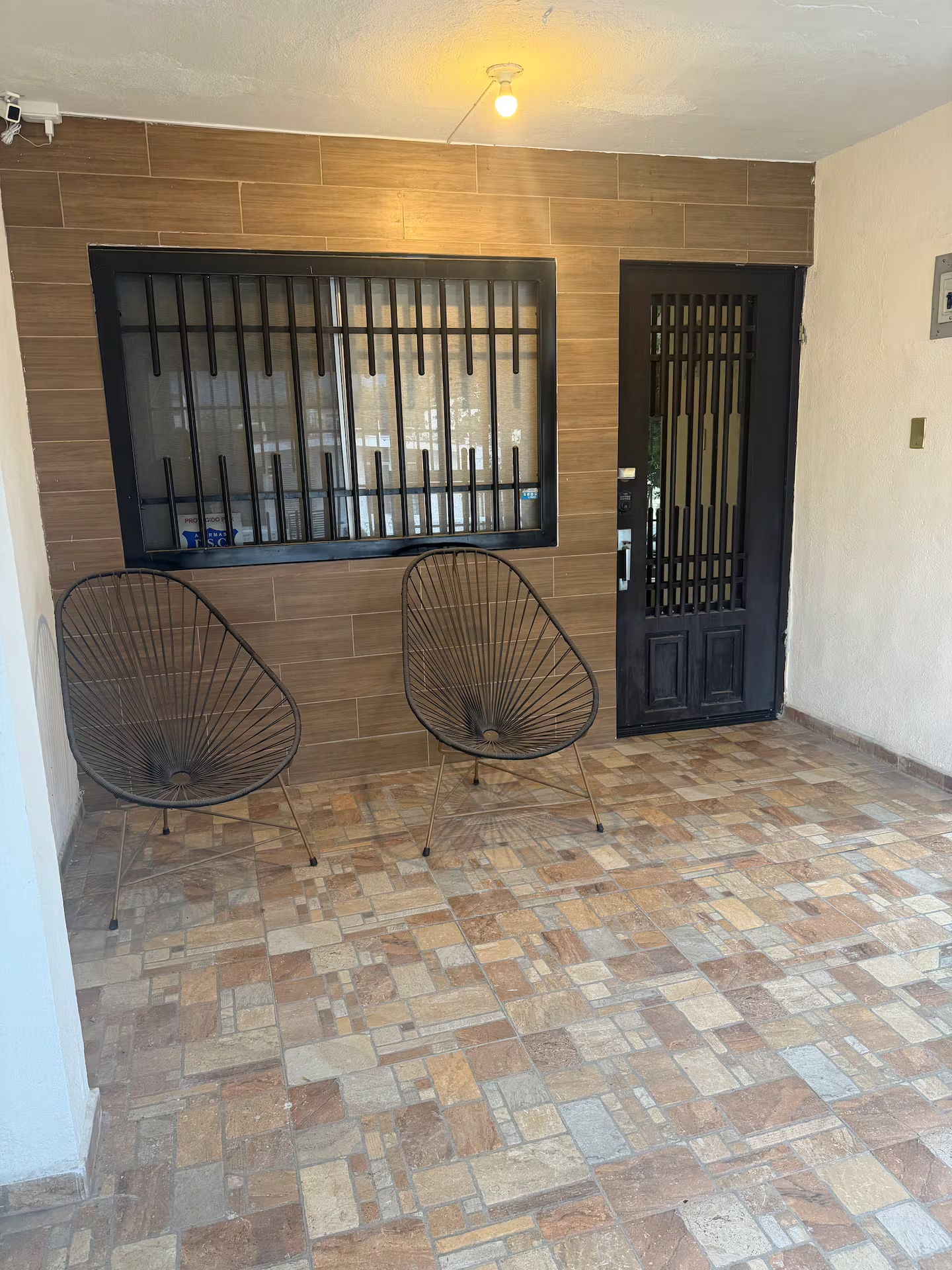
We rent one whole furnished house in Guadalupe, Nuevo León, inside the Monterrey metro area: 3 bedrooms, 5 beds, up to 7 guests, and 1 full bathroom, with an equipped kitchen, WiFi, a washer, TV, free parking and self check-in. We issue a CFDI for the stay and we work in English and Spanish.
We publish the single bathroom because it is the constraint that matters for a crew. It suits groups of around four or five with staggered mornings; for larger groups on one fixed start time it does not, and we would rather say that before you book than after.
This describes how lodging and its paperwork work in practice. It is not tax, legal, or immigration advice — your own accountant should confirm how the expense is treated on your side.